

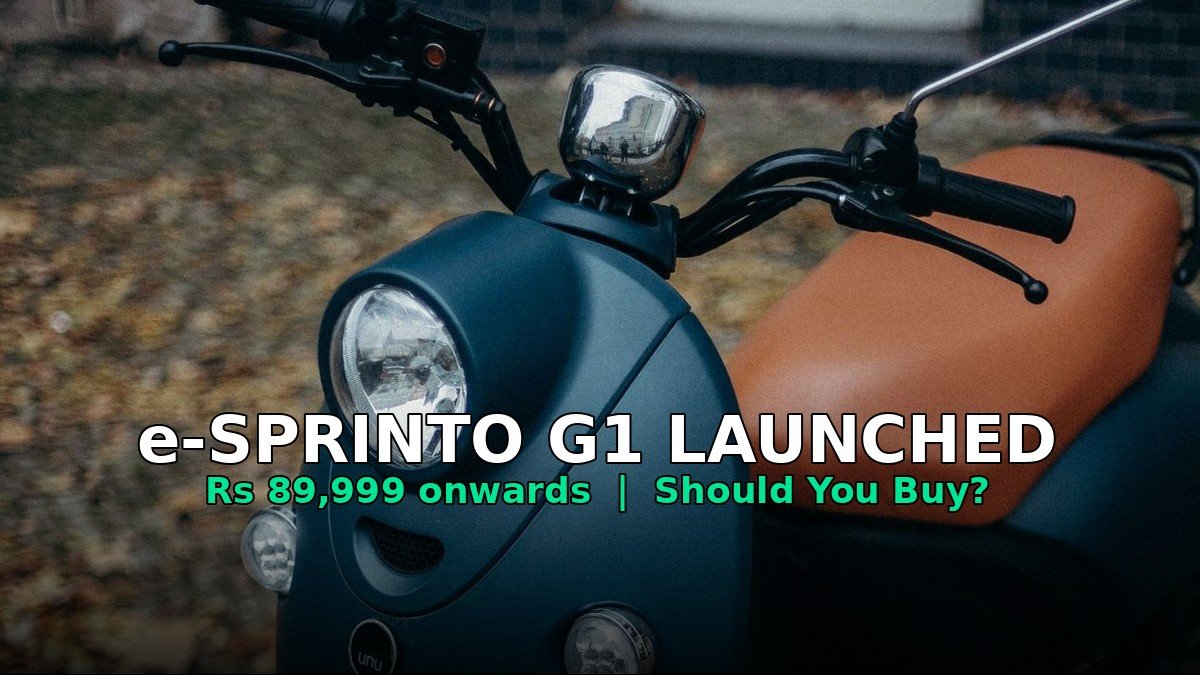
October 2026 is turning into a launch-heavy month for electric two-wheelers in India. A day after the VLF Strada broke cover on 12 October, e-SPRINTO launched the G1, its first electric scooter built for individual and family buyers, on 13 October 2026, with prices starting at Rs 89,999 (ex-showroom, Delhi).
The brand name may be new to you. e-SPRINTO has so far operated in the B2B electric scooter segment, fleet and commercial buyers, and says it runs three manufacturing facilities with an annual capacity of 1.5 lakh units. The G1 is its first serious attempt at winning over Indian families: three battery options, a claimed range of up to 130 km, a 5-year warranty, and a sub-Rs-1-lakh starting price. On paper, it looks strong.
But paper is where every scooter looks strong. Customer deliveries only begin on 1 January 2027, roughly two and a half months away, and no independent reviews or real-world range tests exist yet. So let’s separate what’s confirmed from what’s still a question mark, and finish with an honest verdict: should you book the G1 now, or wait?
e-SPRINTO G1 Price in India: All 3 Variants Explained
The G1 comes in three variants, split purely by battery size. All prices are ex-showroom, Delhi. Your on-road price will be higher once RTO, insurance and handling charges are added:
| Variant | Battery | Claimed range | Price (ex-showroom, Delhi) |
|---|---|---|---|
| G1 2.0 kWh | 2.0 kWh | 80 km (claimed) | Rs 89,999 |
| G1 2.5 kWh | 2.5 kWh | 100 km (claimed) | Rs 94,999 |
| G1 3.0 kWh | 3.0 kWh | 130 km (claimed) | Rs 99,999 |
The interesting bit is the pricing ladder: the jump from the base 2.0 kWh variant to the top 3.0 kWh variant is just Rs 10,000, but the claimed range rises by roughly 50% (80 km to 130 km). If your daily running justifies it, the top variant is the value pick of the three: you are paying mainly for battery, which is exactly where the money should go in an EV.
Battery, Motor and Claimed Range
The G1 uses a 1.5 kW PMSM motor with a top speed of 50 km/h: city-commute territory, not highway. There are three riding modes: Eco (up to 30 km/h), City (up to 40 km/h) and Sport (up to 50 km/h). Listed charging time is around 4.5 hours on a regular home socket.
Now the part that matters more than the brochure: every range figure above is company-claimed, measured under standardised test conditions. Real-world range depends on your speed, traffic, pillion load and how the battery ages. Use this sizing rule instead of the brochure number: take your daily round-trip distance, multiply it by 1.5, and pick a claimed range at or above that. Ride 40 km a day? You want at least 80 km of claimed range if you charge daily, which puts the 2.5 kWh or 3.0 kWh variant on your shortlist, not the base model.
Features and Practical Bits
- Warranty: 5 years / 60,000 km, the strongest headline in this price band. Read the battery-specific terms carefully (more on that below).
- Battery protection: IP67-rated battery packs (dust and water ingress protection under test conditions).
- Everyday practicality: 28-litre boot space, 150 kg load-carrying capacity, 165 mm ground clearance and 12-inch tubeless tyres: sensible numbers for Indian roads and family use.
- Brakes and console: combined braking system (CBS) with front and rear drum brakes, and a digital instrument console.
- Colours: Horizon Blue, Charcoal Black, Pine Green and Slate Grey.
What the G1 Gets Right
Give credit where it is due. First, the sub-Rs-1-lakh entry price with genuine variant choice is rare: most brands force you into one battery size at this price. Second, the scooter is clearly designed around family practicality (big boot, high load capacity, generous ground clearance) rather than gadgetry. Third, the 5-year warranty headline signals confidence, which is exactly what a new consumer brand needs to project. And fourth, the timing is smart: with the PM E-DRIVE subsidy window running till 31 March 2028, buyers shopping now are doing so inside the incentive period.
On the subsidy itself, one honest note: the scheme offers Rs 2,500 per kWh capped at Rs 5,000 per vehicle for models within the price cap. But confirm with the dealer whether the G1 is eligible and whether the benefit is adjusted on your invoice. Do not take “subsidy included” on word alone for any brand-new launch.
The Honest Concerns (Read Before Booking)
1. Deliveries are two and a half months away. Booking now means your money sits with the dealer until January 2027. That is fine if you are planning ahead, but know what you are signing up for.
2. A B2B brand going consumer is unproven. e-SPRINTO knows fleet buyers; family buyers are a different game: showroom experience, service quality, spare-part availability. New does not mean bad, but it does mean you should ask harder questions about the service network in your city before booking.
3. Zero independent reviews exist. No journalist or owner has ridden a production G1 yet. Every opinion you read right now, including this one, is based on launch specifications, not road experience. Treat early “reviews” of any new launch with the same scepticism.
4. Resale and spare-part unknowns. With a brand-new consumer model, nobody can tell you the 3-year resale value or how quickly a damaged body panel gets replaced. Established rivals charge partly for that certainty.
Who Should Consider the e-SPRINTO G1
- Your budget is firmly under Rs 1 lakh and you want a family-oriented city scooter.
- Your daily running is 30–50 km, making the 2.5 or 3.0 kWh variant’s claimed range comfortable.
- You can wait until January 2027 for delivery without trouble.
- You have verified a service point reasonably close to home, or the dealer gives you that commitment in writing.
Who Should Wait (or Look Elsewhere for Now)
- You need a scooter in the next few weeks, the G1 simply cannot reach you in time.
- There is no service centre near you and the brand cannot name one opening soon.
- You want real-world reviews first, entirely reasonable for a first-generation product from a new consumer brand.
- You are stretching your budget to Rs 99,999 for the top variant. At that point, compare hard against established models with proven service networks before deciding.
5 Questions to Ask the Dealer Before You Book
- Battery warranty terms: full replacement or pro-rata? And is the battery covered for the full 5 years / 60,000 km, or fewer kilometres than the vehicle warranty?
- Service network: where is the nearest service centre to my home, what are typical spare-part waiting times, and is doorstep service offered?
- Subsidy: is this specific variant eligible under PM E-DRIVE, and will the benefit be shown adjusted on my invoice?
- Booking terms: what is the booking amount, is it refundable, and will you give the delivery timeline in writing?
- On-road price: give me the full breakup: ex-showroom, RTO, insurance, handling, line by line, with nothing bundled opaquely.
Verdict: Should You Buy the e-SPRINTO G1 Now or Wait?
The G1 is a genuinely tempting package on paper: honest variant strategy, family-first practicality, aggressive pricing and a strong warranty headline. If e-SPRINTO delivers on service, it could embarrass several established names in the sub-Rs-1-lakh band.
But “on paper” is doing a lot of work in that sentence. With deliveries starting January 2027, the smart money waits: let the first batch reach customers, watch early ownership reports through February–March 2027, and then decide with real data instead of launch claims. You lose nothing by waiting; early buyers absorb all the risk.
The one exception: if you have verified a solid service point near you, you are comfortable with the waiting period, and the dealer answers all five questions above in writing, then booking the 3.0 kWh variant at Rs 99,999 is a defensible, well-priced bet. Otherwise, patience is the better buying strategy here. Check the answers first, sign later.