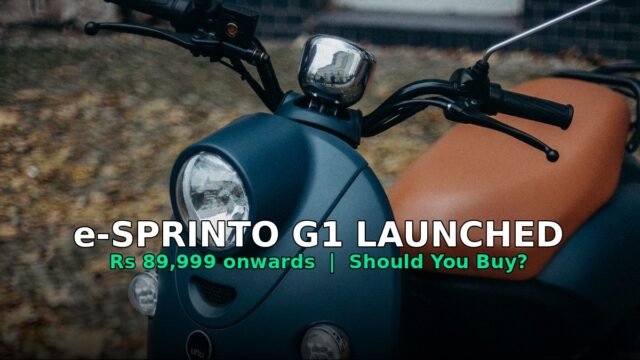

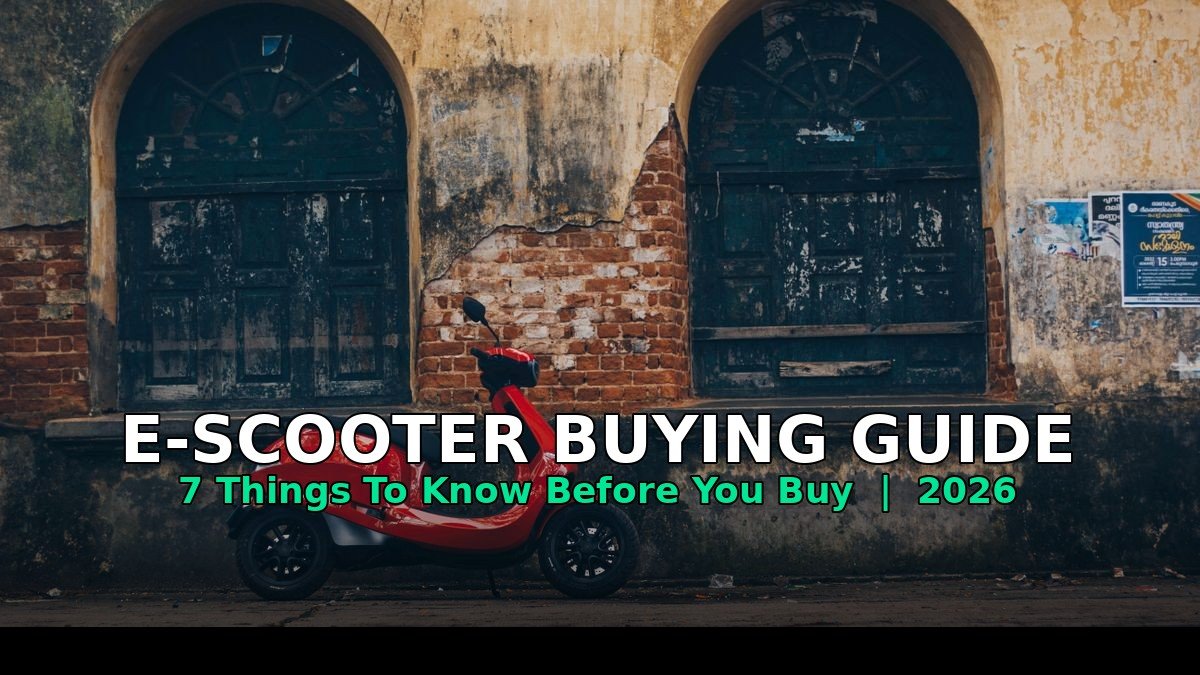
October 2026 is a busy month for electric scooters in India. The e-SPRINTO G1 launched on 13 October starting at ₹89,999, and the VLF Strada followed on 12 October with prices around ₹1.20 lakh. The PM E-DRIVE subsidy scheme has been extended till 31 March 2028. In other words: it is a buyer’s market right now. This electric scooter buying guide India 2026 will help you make the most of it.
But showrooms sell brochures, not reality. Before you visit one, this electric scooter buying guide India 2026 lays out the 7 things that actually decide whether you’ll love your electric scooter or regret it.
1. Claimed range is not your range
Every manufacturer advertises a “claimed range”, measured on the IDC (Indian Driving Cycle), a lab test with a single light rider, no pillion, and gentle speeds. Your daily ride looks nothing like that.
Look at this month’s launches. All figures below are company-claimed:
| Scooter | Battery | Claimed range |
|---|---|---|
| e-SPRINTO G1 (2.0 / 2.5 / 3.0 kWh) | 2.0–3.0 kWh | 80 / 100 / 130 km |
| VLF Strada City | 2.16 kWh | ~130 km |
| VLF Strada Max | 4.32 kWh | ~250 km |
| E3 Trion C1X | 3.0 kWh | 165 km |
Use this sizing rule instead of the brochure: take your daily round-trip distance, multiply by 1.5, and buy a claimed range at or above that number. Ride 40 km a day? Look for at least 60 km of claimed range if you charge daily — 80 km or more if you want to skip a day between charges. This buffer covers traffic, pillion weight, and the gradual range drop as the battery ages.
And on the test ride, ride your route, with a pillion if that’s how you’ll actually use it.
2. Battery size (kWh) matters more than the model name
Think of kWh as the size of the fuel tank. A 3.0 kWh battery simply stores more energy than a 2.0 kWh one — that’s why the top G1 variant (3.0 kWh, ₹99,999) claims 130 km while the base (2.0 kWh, ₹89,999) claims 80 km. You’re paying ₹10,000 more for roughly 50% more range. That trade-off is worth doing on paper before you fall for a colour or a touchscreen.
Two more battery questions that matter:
- Chemistry: LFP vs NMC. LFP (lithium-iron-phosphate) batteries last more charge cycles and handle Indian summer heat better; NMC packs more range per kilo. The VLF Strada uses removable LFP batteries, a durability-first choice that suits city commuting.
- Removable vs fixed. The Strada City and the E3 Trion C1 come with removable batteries you can carry upstairs to charge. If you live in an apartment with no charging point in the parking, this single feature can decide the purchase.
3. Charging: start with the 15A socket question
Most electric scooters in India charge from an ordinary 15A home socket: no special wiring needed for overnight slow charging. A full charge typically takes a few hours, so plugging in at night and riding all day works for most commuters.
Do the energy math once, with your own electricity tariff. As an example, at ₹8 per unit: a full charge of a 2.5 kWh battery costs about ₹20. If that gives you roughly 80 km of real city riding, your energy cost is around 25 paise per kilometre. Compare that with petrol and the running-cost story tells itself (we’ll do the full 3-year petrol-vs-electric calculation in a separate article).
Before buying, ask the dealer three things: the charger’s wattage (it decides charge time), whether a removable battery can charge indoors, and whether your housing society allows a socket near your parking slot.
4. Warranty fine print: what “5 years” actually covers
The e-SPRINTO G1 launched with a 5-year / 60,000 km warranty, strong on paper, and exactly the kind of headline you should read twice. The battery is the single most expensive part of an electric scooter, so the battery warranty terms matter more than the headline number.
Ask: is the battery covered for full replacement or pro-rata (where you pay a share as it ages)? How many kilometres is the battery itself covered for, sometimes less than the vehicle warranty? And what voids it: frequent fast-charging, deep discharges, or third-party repairs? Get the answers in writing on the invoice, not as showroom promises.
5. Subsidy: PM E-DRIVE puts up to ₹5,000 back in your pocket
The central government’s PM E-DRIVE scheme for electric two-wheelers now runs till 31 March 2028. The incentive is ₹2,500 per kWh of battery, capped at ₹5,000 per scooter, for models with an ex-factory price up to ₹1.5 lakh.
Here’s the useful math nobody puts on the poster: 2.0 kWh × ₹2,500 = ₹5,000. So any scooter with a 2 kWh or bigger battery gets the full ₹5,000 benefit: the cap, not the battery size, is what limits you. (A 3 kWh battery would calculate to ₹7,500, but the ₹5,000 cap applies.)
Watch the price cap, though: the VLF Strada Max at around ₹1.55 lakh sits above the ₹1.5 lakh ex-factory limit — confirm with the dealer whether the benefit applies to that variant. And always ask the dealer to show the subsidy adjusted on your invoice, and to confirm the specific model’s eligibility. Don’t take “subsidy included” on word alone.
6. Service network: the unsexy dealbreaker
New brands are launching aggressively: e-SPRINTO built its business in the B2B fleet segment before selling to families, and VLF sells in India through Kolhapur-based Motohaus. New doesn’t mean bad, but it does mean you should ask harder questions: how many service points exist in your city, what’s the typical spare-part waiting time, and is there doorstep service?
An electric scooter needs less routine servicing than a petrol one (no engine oil, no spark plugs), but when something electronic fails, you can’t take it to the corner mechanic. A 30 km trek to the nearest service centre gets old fast. Weigh network strength against the sticker price — established players charge for that reach.
7. Think in total cost, not sticker price
A ₹89,999 scooter that costs 25 paise/km to run beats a cheaper-feeling deal that drains your wallet daily. Beyond fuel, factor in two things buyers forget:
- Insurance for EVs is priced a little differently (battery add-ons exist): get quotes before finalising the budget.
- Resale is decided by battery health. Keep service records, avoid running the battery to zero regularly, and prefer models with a transferable battery warranty. A well-kept battery is what the second buyer is actually paying for.
Electric scooter buying guide India: your 7-question showroom checklist
- What range will I get on my daily route, with a pillion?
- Battery chemistry and exact kWh?
- Full charge time on a regular 15A socket?
- Battery warranty: full replacement or pro-rata, and for how many km?
- Is the PM E-DRIVE benefit applied on my invoice, and is this model eligible?
- Where’s the nearest service centre, and how long do spares take?
- Full on-road price breakup: ex-showroom vs RTO vs insurance, line by line.
Buy on these seven answers, not the brochure, not the touchscreen. With fresh sub-₹1-lakh launches and the subsidy running till March 2028, late 2026 rewards the buyer who checks first and signs later.